

How to help kids understand others’ emotions
Practicing noticing and naming emotions in others


Bite-sized mental health skills for real parents 🌸
Last week, we recommended Little Faces Big Feelings, which highlights the concept of naming emotions in others — the idea that noticing and naming other people’s feelings helps kids build their emotional intelligence (read that post here). This week, we share some resources to help you practice noticing and naming emotions with your kiddo at home, and answer your real-life questions about expressing emotions around kids.
Buy Little Faces Big Feelings or preview most of the book here
How to Practice Naming Emotions with Your Child
We want to make talking about other people’s emotions feel as approachable as possible. Here are some ideas of how you can talk to your child about other people’s feelings. We’ve included some comments to help you understand why we recommend these steps.
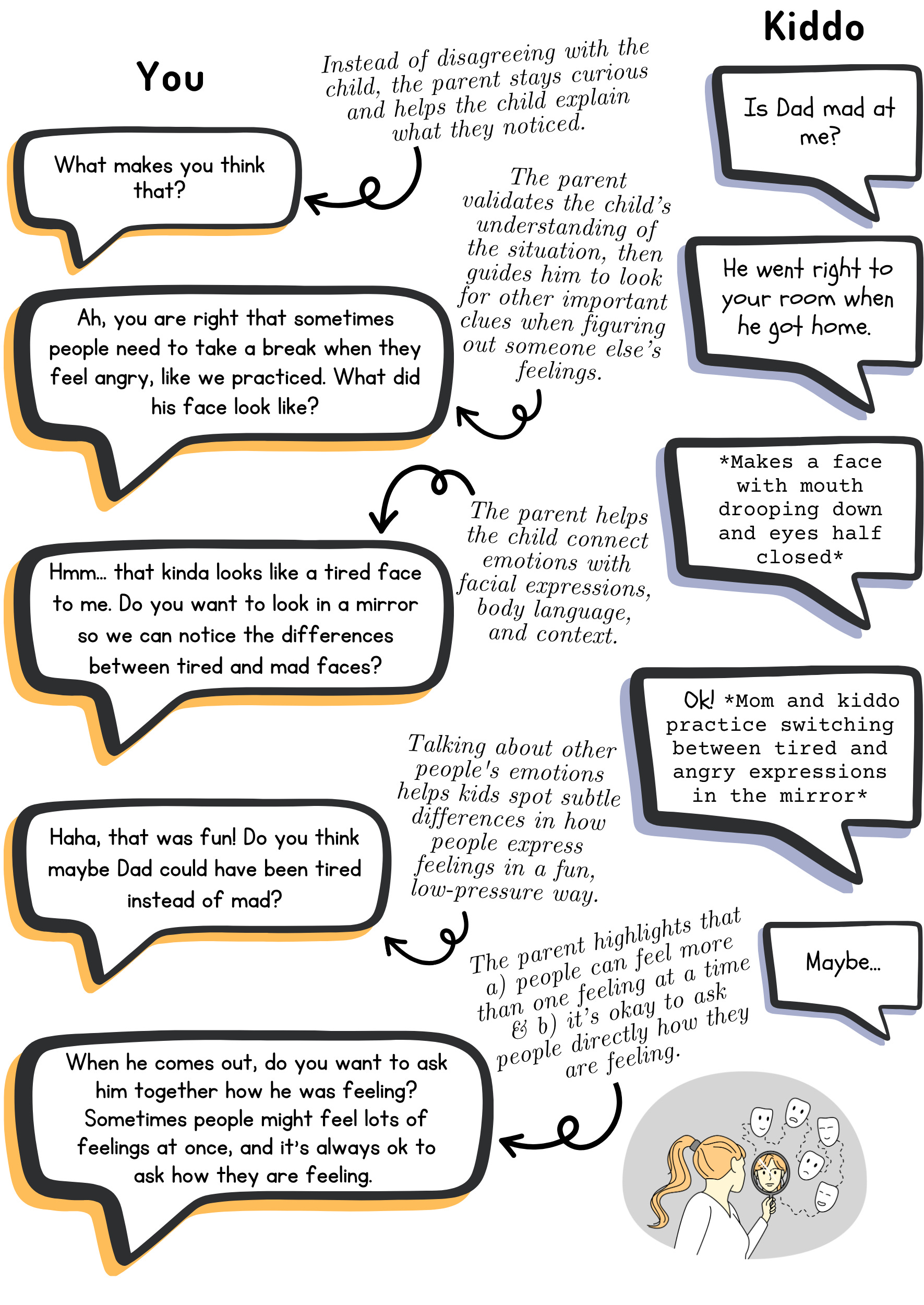
This example shows how kids can sometimes misinterpret others’ emotions and why it can be helpful to practice noticing and naming others’ emotions with them. During these conversations, it’s also important to remember that the same emotion can look very different on two different people, so the more versions of emotional expression they are exposed to, the better they can recognize and empathize with others’ experiences.
Questions From Our Community About Naming Emotions
Q: I want to practice naming and expressing emotions in front of my child, but sometimes the situations that I feel strongly about are topics I wouldn’t normally discuss with my child (like my disagreements with my partner). Is it important to express my emotions in front of my child even in these moments, or can I be more selective about when I name my emotions in front of my child?
A: Thank you so much for asking such a specific question! The first thing we would recommend considering is: what is the purpose of sharing this emotion with your child?
If your child is noticing that you are having a strong feeling, or if the feeling is getting in the way of parenting the way you want to, that might be a moment to name it in a simple, honest, age-appropriate way (keep an eye out for a future post where we discuss talking with kids about hard topics in more detail 🌸). This does not mean going into all of the adult details or necessarily naming the other people involved. You might say something like, “You’re right, I am feeling frustrated. I had a tough conversation today, and I’m thinking more about it,” or “I’m feeling angry because I felt misunderstood earlier, but you did nothing wrong.”
The most important thing is that if your child is noticing your emotion, you want to help them make sense of what they are seeing. Sometimes, when kids can tell something is off, and we say, “No, I’m fine, everything’s fine,” that can be confusing for them or make them start to distrust their own judgment and emotional interpretation. But, this doesn’t mean you need to bring up every adult emotion just for the sake of teaching emotional expression. There will be plenty of natural moments where your child sees you have a strong feeling, name it, and cope with it.
One other important distinction is that modeling emotional expression is different from seeking emotional support from your child. It is okay to help them understand what they are witnessing, but we do not want them to feel responsible for comforting us, solving the problem, or carrying the adult emotion. Thank you for being such a thoughtful member of our community, and keep the great questions coming!
Go deeper on the science of naming emotions:
We love this article, which talks about how reading picture books can help kids develop their emotional vocabulary — speaking our language!
Here’s a fun emotion-naming activity from Sesame Street! (This is an online activity with real kids’ faces showing a TON of different emotions!)
Play emotion charades! Pick an emotion and ask your child to show the feeling with her face. You can trade off, practicing expressing emotions! Here are two video versions of a “name that emotion” game, one from Inside Out and one from Sesame Street.
Want to go deep into the scientific literature on how kids learn emotions? This article from Annual Review of Developmental Psychology argues that we should stop thinking about recognizing emotions — which implies that emotional cues are unambiguous — and start thinking about reasoning about emotions — making inferences and predictions about other people’s emotional states based on the information available.
You can also listen to this interview with Lisa Feldman Barrett, one of the world’s most famous emotion researchers, about how our brains make emotions from information inside and outside our bodies.
Do you notice your child noticing when other people feel sad or angry? Have you talked to your child about emotions you see in the wild? Share your experiences or questions about naming emotions in the comments!
FYI: The links above for buying Little Faces, Big Feelings are affiliate links (see this page for more information).