

How to talk about exposure with your child
Practicing a skill for overcoming anxiety and fear.


Bite-sized mental health skills for real parents 🌸
As a reminder, we’re trying something a bit different this week. We want to create space to answer your questions about each post’s mental health skill before we introduce a new topic. So we’re trying out a new schedule — we’ll introduce a new evidence-based skill and accompanying kids’ book every other week, and on the alternate week, we’ll offer examples and answer your questions about using the skill in your real life. We’re hoping this change makes our posts even more digestible for busy parents. We’d love to hear what you think about this new format, or other ideas for how we can improve Minds in Bloom. Tell us what you think in the comments or over email: mindsinbloombooks@gmail.com 🌸
Last week, we recommended Orion and the Dark, which highlights the concept of exposure — the idea that approaching things we’re afraid of makes them less scary and builds confidence (read that post here). This week, we are sharing some resources to help you try exposure with your kiddo at home, and answering your real-life questions about exposure and fear.
Buy Orion and the Dark or listen online for free
How to Talk About Exposure with Your Child
We want to make practicing exposure feel as approachable as possible. Here are some ideas of how you can talk to your child about fear and exposure. We’ve included some comments to help you understand why we recommend these steps.
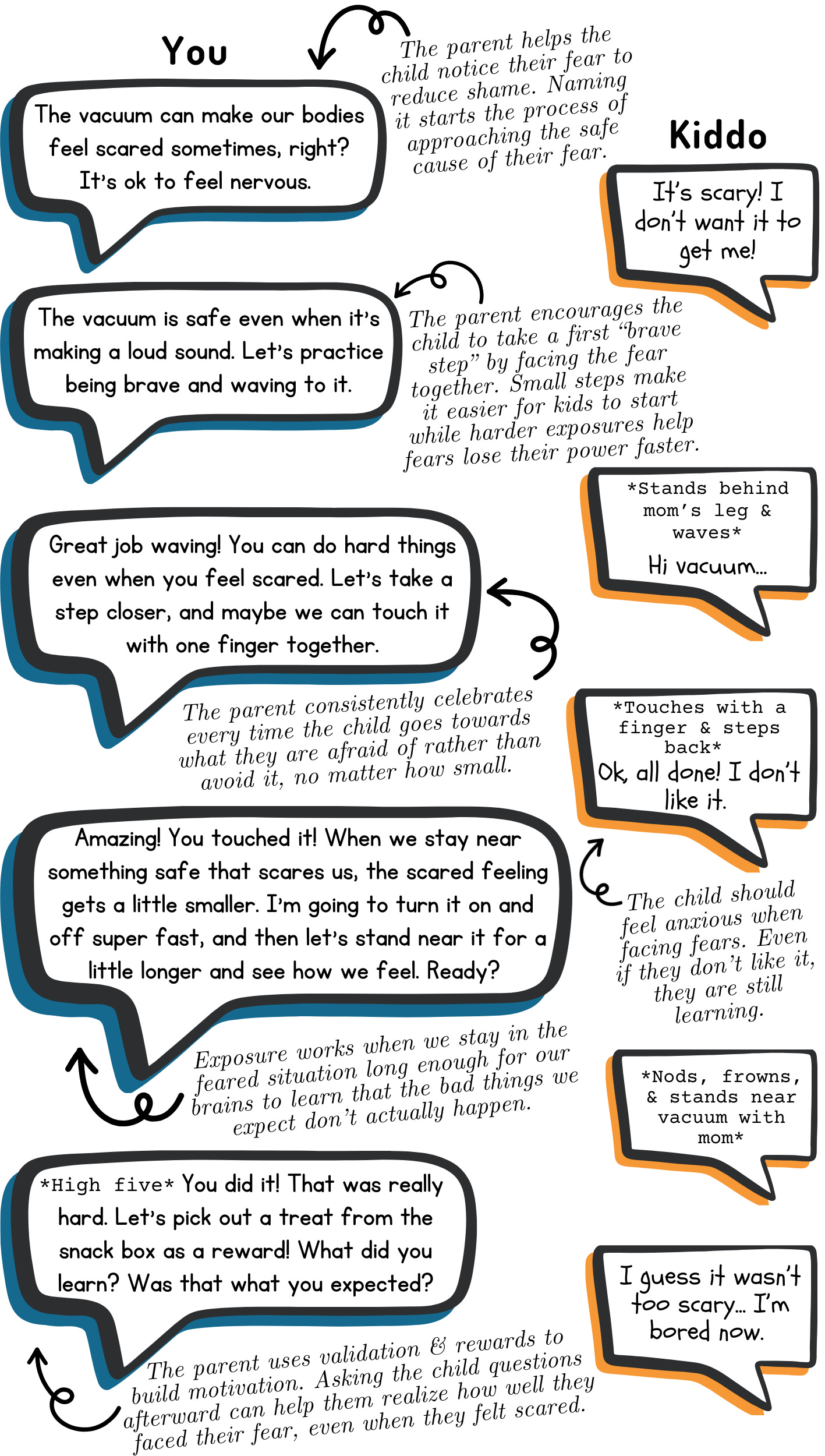
Remember that kids usually need to practice facing their fears multiple times and working up to harder situations to get the full benefit from exposure. With consistent practice, their scared feeling will start to get smaller, and they will begin to feel more confident about approaching their fears.
Questions From Our Community About Exposure and Fear
Q: What’s the best way to respond when my toddler gets startled by things, like a dog barking or the fridge alarm going off?
A: Great question! Fear is an important human emotion that helps us stay safe, and it’s important that kids learn to trust their fear instinct. On the other hand, we don’t want kids to feel paralyzed by fear — we want to teach them to engage in the world with caution and awareness when they feel scared. Parents can pay attention to what their child is afraid of and use this to guide their response. For situations that do present some amount of danger (realistic fears), the goal is to help kids learn to listen to their fear and respond with safety skills. For situations where the fear is unrealistic or where danger is highly unlikely, the goal is to help the child bravely face their fear. Often, kids are still learning what realistic and unrealistic fears are, so parents play an important role in helping them learn the difference.
Alarms and barking dogs could both be considered realistic fears. They contain potentially important safety information — many alarms exist to help us stay safe, like car horns or fire alarms, and a dog barking can signal that the dog needs space. It’s also very normal for kids to be startled by these types of loud noises. We don’t want to encourage kids to ignore information that could help them stay safe, but we also don’t want to encourage avoidance of a safe situation, like running out of the kitchen every time the fridge alarm goes off.
Situations that contain real signals of potential danger can be a great opportunity to help kiddos practice safety skills. Parents can teach their kids how to check in with a trusted adult about the scary situation to help them distinguish safe from unsafe things, like asking an adult, “Is the fridge ok?” or practice approaching the scary thing together to learn if it is safe or not. Another option is to plan ahead of time how to respond safely to realistic fears, like discussing how to safely retreat from sounds that signal threat. For example, your child probably doesn’t need to check in with you every time your family dog barks at the mail delivery. But if an unfamiliar dog is barking in your yard, you can teach them a clear safety plan: Back up slowly, go inside, and call for a trusted adult.
Either way, the goal is to help the child trust their own fear instincts and learn to stay safe around realistic and likely dangers, while approaching rather than avoiding unrealistic fears. Next week, we will talk more about teaching kids safety skills — stay tuned!
Q: My 4-year-old sometimes says he is afraid of ghosts, so I made a “ghost spray” to use to “scare ghosts away.” Is that helpful or hurtful?
A: This is a great example of a common yet unrealistic fear — we know that ghosts won’t cause kids harm. When kids fear unrealistic things like ghosts or monsters, parents can really lean into using exposure to help their kids overcome these fears.
This reader asked about ghost sprays, and we often see parents trying everything under the sun to help their kids feel better in the face of anxiety. Unfortunately, ghost spray is an example of something that may be inadvertently keeping anxiety alive — it may work in the short-term to temporarily reduce the kiddo’s anxiety, but it doesn’t help the kid overcome the fear in the long term, and could have the added downside of making the kid think they NEED the ghost spray to be okay. This is a good example of what we call avoidance — things kids and adults do to help themselves not have to face their fears. When we do anxiety treatment, we work with families to reduce avoidance behaviors to help the child overcome their fears fully. Approaching the feared situation and testing out whether the fear is likely to happen is the best way to challenge the strength of the unrealistic fear.
What could a parent do instead in this situation? A childhood exposure expert we know would probably say, “You don’t need a ghost spray, you need a ghost summoner!” Rather than trying to keep the ghosts away, an exposure framework would lead us to try and get the ghosts to come towards us (aka approach the fear rather than avoid it). This would involve working with the child to create a list of places and situations where they believe a ghost encounter is most likely to occur (in the closet? in the basement? at nighttime?), and then gradually approaching those situations, from easiest to hardest. Through repeated exposures, the kiddo will have the important experience of learning that 1) the ghosts never come, even when we try to approach them, and 2) if a scary noise (like a house creak) does happen after they “summon” a ghost, that they can handle that scary sound. Even though it might feel really hard to sit with the fear at first, with repeated practice of facing their unrealistic fear in different ways and different places, they will start to learn they are safe, and their anxiety will get smaller over time.
Remember, exposure can be fun, even when it's really hard. Maybe this is a chance to set out the ghost’s favorite toy, to see if he comes to play, or throw a tea party and invite some ghosts to tea. 👻
Go deeper on the science of fear and exposure:
We love this handout from Seattle Children’s Hospital on steps parents can take to help kids struggling with fear/anxiety, and this instruction guide from the Mayo Clinic on how to do parent-coached exposures.
This article and video from Baylor University go in depth on how avoidance keeps anxiety alive, using the example of being afraid of talking to another person (a social fear).
This worksheet from an anxiety-focused non-profit is a great option for helping young kids hop like a bunny “down the worry path” to face their fears one small step at a time.
To learn more about the science behind why it is so helpful for parents to help coach their kids through their exposure practice, check out these two recent trials.
Also from Baylor, the Learning to Understand and Navigate Anxiety (LUNA) lab offers free online resources for doing exposure therapy with both younger children and teens. This is a great resource for parents who want more structured support for trying out exposure therapy at home.
Do you notice your child having moments of fear or anxiety? Have you considered trying exposure? Share your experiences or questions about fear and anxiety in the comments!
FYI: The links above for buying Orion and the Dark are affiliate links (see this page for more information).