



Clinical psychologists picking kids books rooted in mental health science 🌸
Mad, Mad, MAD: A board book about regulating anger for toddlers (age 1+)
Each week, we recommend one kids book that teaches a mental health concept. Today, we’re sharing a book that tackles anger and tantrums: Mad, Mad, MAD, written and illustrated by Leslie Patricelli. This book highlights why meltdowns happen: When anger gets too big, toddlers and young kids just can’t think straight! Read on to learn why we recommend Mad, Mad, MAD to the parents we know, the science behind anger, and tips for helping your child when they are so mad that nothing else works!
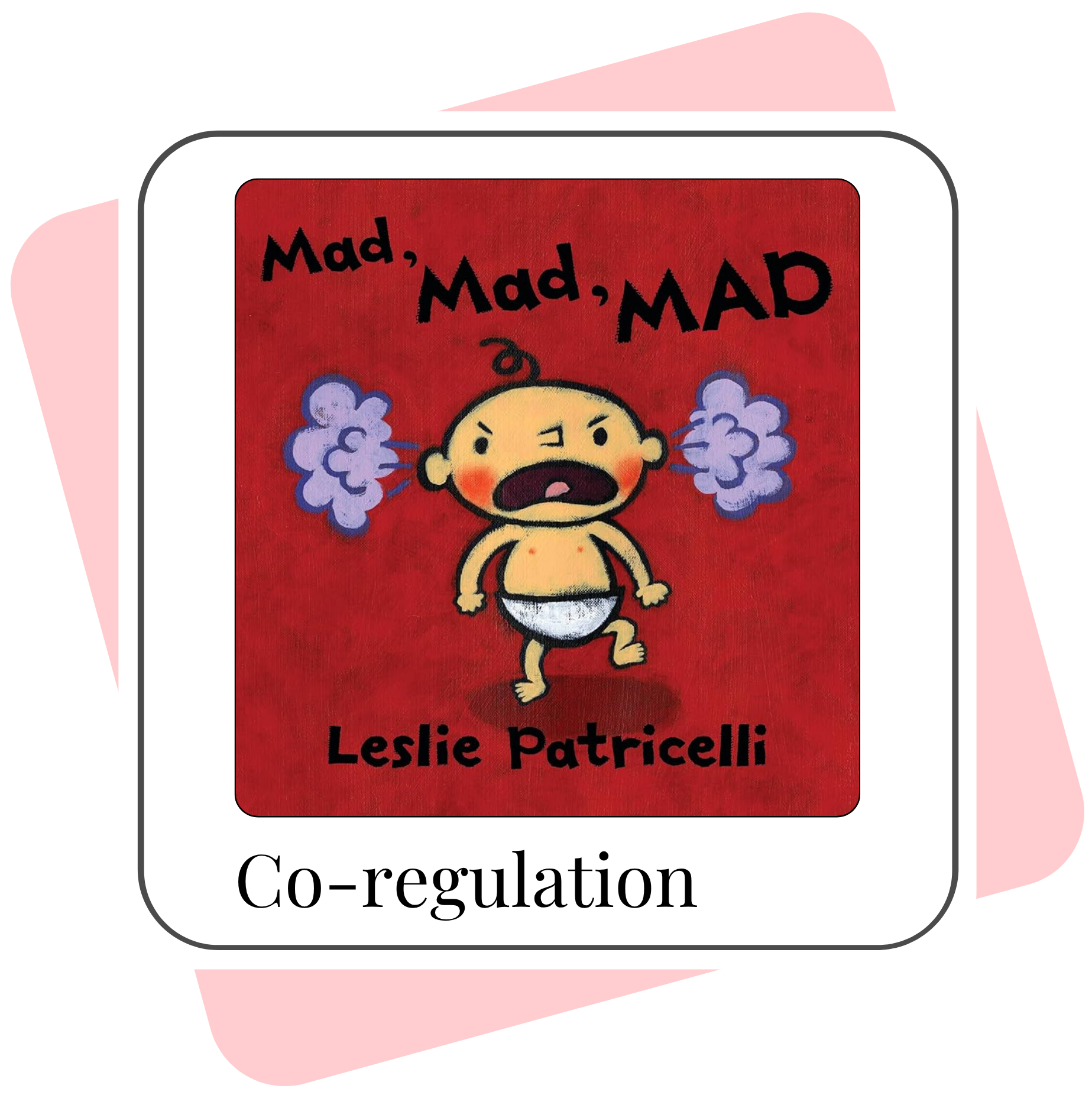
About the Book
Mad, Mad, MAD is the story of a baby who gets red-hot angry! The baby’s parents try everything they can think of, but at first, nothing seems to work. We love how this book showcases that when children (and adults) pass their anger “tipping point,” rationality goes out the window. In these moments, a skill called co-regulation can help more than conversations. In the book, the baby’s parents use co-regulation — they stop trying to problem-solve and instead calmly offer him validation and comfort (bringing him his blanket, giving him hugs, and carrying him around). We love how this book highlights what parents can do when kids pass their anger tipping point!
Buy Mad, Mad, MAD or listen online for free
What Science Tells Us about Anger and Meltdowns
First, let’s talk about what happens in our brains during a meltdown or tantrum. When we get really angry, our amygdala (the part of the brain responsible for noticing danger) thinks something bad is happening and makes our hearts beat fast, our blood flow quickly making us hot, and our muscles tense. This is called the “fight or flight” reaction — our body is preparing to go into action to protect ourselves (like revving a car engine).
Usually, a different part of the brain — the prefrontal cortex — helps to keep the amygdala from reacting too strongly, like the brakes on a car. But when anger is strong, the brakes have a hard time slowing the car down, and the fight or flight reaction gets bigger. At this point, our brain has trouble thinking clearly or listening to others because it is just focused on keeping us safe. We call the point at which we get so mad it becomes hard to think the “anger tipping point,” but it is also called “amygdala hijacking.” Everyone hits their anger tipping point sometimes. Toddlers and young kids hit their anger tipping points frequently because their prefrontal cortex is still growing.
Many strategies for dealing with anger involve a lot of thinking. These skills are helpful for smaller feelings of frustration and older kids, but often don’t work well for toddlers above the anger tipping point. These include:
Trying to teach your child why they don’t need to be mad using reason and logic — like saying “I know you are mad, you’ll get to play with that toy again tomorrow!”
Trying to problem-solve or compromise like, “Do you want to ____”
Trying to discuss their anger, like asking, “Why are you mad?”
Suggesting coping skills like deep breathing or visualizing something calm.
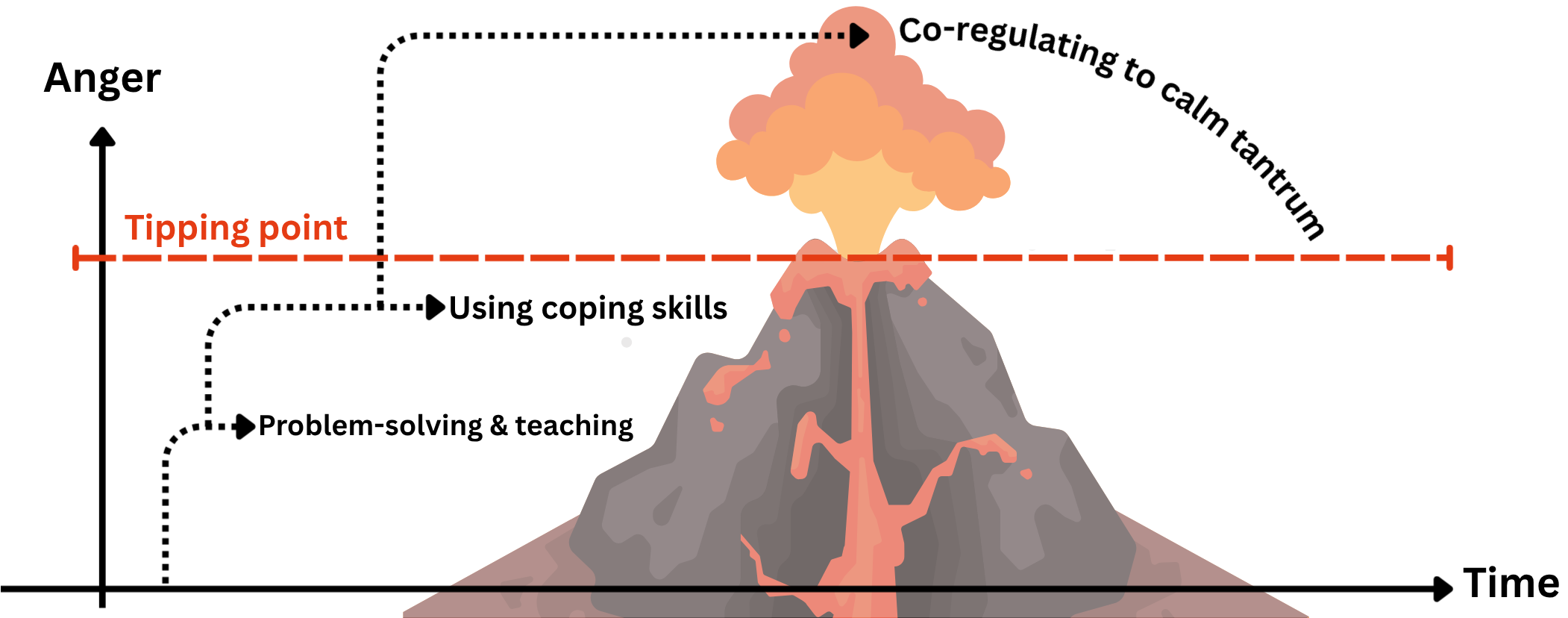
In Mad, Mad, MAD, the baby hits his anger tipping point. We can tell because the parents try talking to the baby, but he just cries and yells in response — he isn’t able to think rationally.
So what can parents do when toddlers cross their anger tipping point? This is where we use co-regulation — a set of strategies designed for moments when a young child’s brain is so angry it can’t process information effectively (i.e., a temper tantrum). During co-regulation, the parent steps in to help guide the child through the meltdown. Parents who are co-regulating with their child don’t talk much and instead provide comfort, safety, and calm as the kiddo’s emotional storm passes. Note that co-regulation is designed for toddlers and young kids, and as children get older, their brains can start learning more skills for coping with anger independently.
Here’s what co-regulating with your child involves:
Before you start, remind yourself that you’re changing your strategy. Recognize that your child’s brain is so “hot” in this moment that talking to your child like you normally do is unlikely to work. Instead, try these steps:
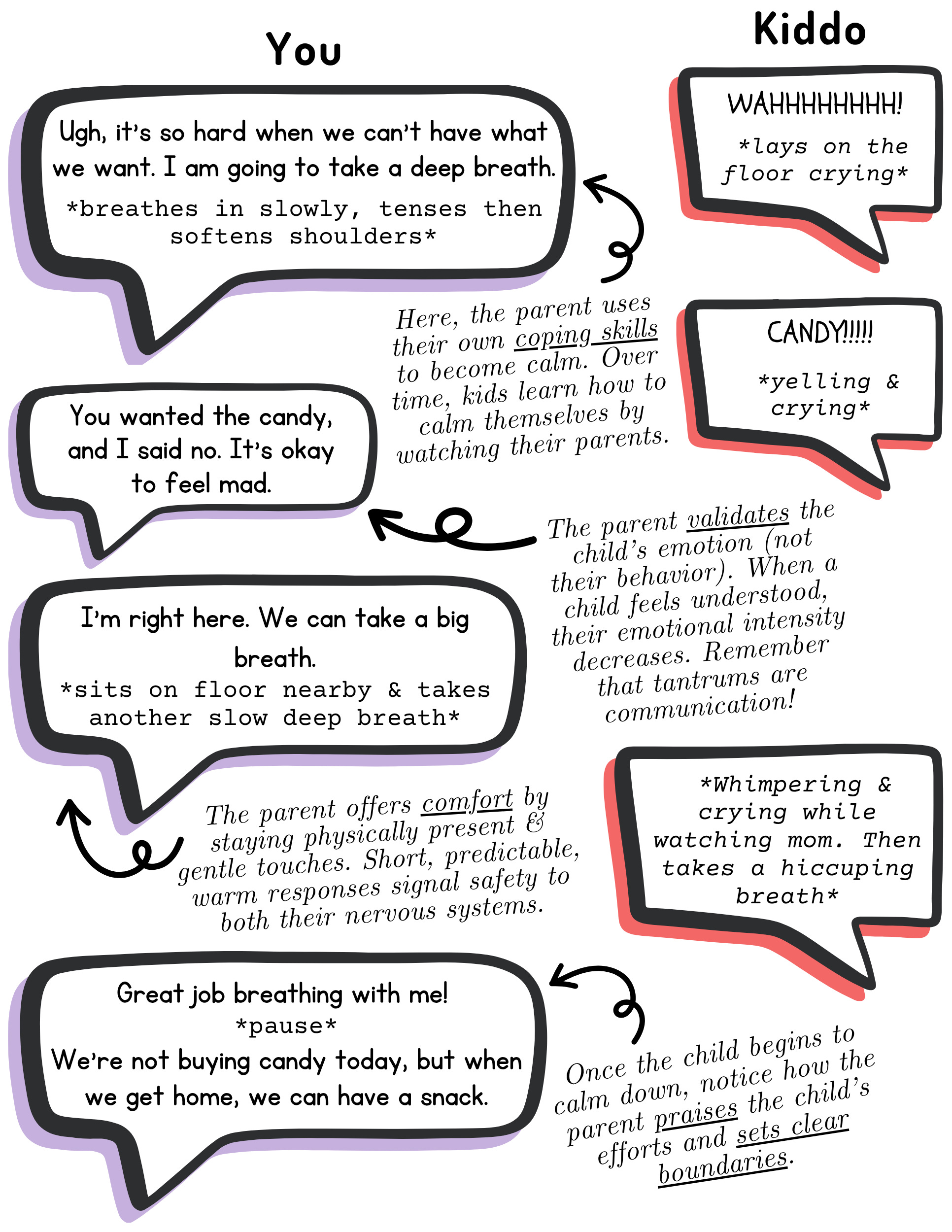
Use your coping skills to calm your own frustration. Parents feeling frustrated during a meltdown is completely normal — parents aren’t robots! When parents use coping skills, it does triple duty: It helps parents reduce their own distress, improves parents’ ability to respond effectively (since co-regulating is hard to do when a parent is activated), and models safe soothing techniques for the child.
Offer comfort to your child. Parents can offer comfort by resting a hand on the child’s back, or offer your lap for them to sit in (if they tolerate touch).
Validate your child’s intense anger using short, simple sentences. This can sound like “you’re mad,” or “this is hard.”
Once your child begins to become calmer, praise what they’re doing to regulate themselves. You can offer praise if they slow their body, quiet their voice, or express anger safely. This lets them know that calm and safe behaviors get your attention. Kids repeat behaviors that get attention! We don’t react much to meltdown behaviors, so kids learn that meltdowns don’t get your attention.
When the tantrum is over, you can guide your child to re-engage in the next activity or task at hand while maintaining a clear boundary. Restate the limit that started the tantrum, then gently redirect their attention to something the toddler can control.
How to Use Co-Regulation with Your Child
Co-regulation can seem complicated, but you might be surprised by how simple it looks and sounds in practice:
What Betsy likes about Mad, Mad, MAD: I love how this book demonstrates the bind parents can find themselves in when a kid crosses their anger tipping point. When the baby’s dad suggests going outside, the baby screams, “No!” but staying inside makes the baby scream even louder, “I don’t want to stay!” Nothing is right for the baby in that moment! These unpredictable reactions can be frustrating and demoralizing for parents — during meltdowns, it’s easy to think things like, “I can’t do anything right.” This underscores how important it is for parents to be kind to themselves during meltdowns. I like to remind myself, “tantrums are normal toddler communication, AND this is really hard.”
What Marin likes about Mad, Mad, MAD: I hear a lot of worries from parents that I work with about what it means for their child’s future mental health if their little one is having such big reactions as a toddler. I think this book does a great job of showing that intense tantrums and meltdowns are completely normal at this age. I like to remind parents that tantrums are a toddler’s way of communicating big wants and needs. When parents stay calm, they show their child that frustration is manageable and that relationships remain safe even during big emotions. I was inspired by the book’s examples of how a child can be empowered to try out self-soothing skills while their parents provide co-regulation, highlighting how even small, simple acts of support can begin shaping a child’s ability to cope with big feelings from an early age!
Go deeper on the science of co-regulation and managing meltdowns and anger tipping points:
For more information about what tantrums are and what to do during an active tantrum, check out Minds in Bloom’s Tips for Toddler Tantrums 🌸
For parents who want to go deeper on tantrums and meltdowns, this post from the Child Mind Institute offers lots of helpful information and advice.
We love this video from Sesame Street, which shows how helpful co-regulation from a trusted adult can be when a child is having a “monster meltdown.” This video also shows the steps the parent takes to calm himself down during his child’s tantrum.
Check out this article to learn more about the science behind why parents' modeling emotional regulation is foundational to child development.
Want to learn more science-backed skills for managing challenging behavior? Yale Professor Alan Kazdin is an expert in this topic, and we love his book, The Everyday Parenting Toolkit, which focuses on parenting strategies for difficult behavior. Dr. Kazdin also offers a free class on this topic through Coursera (heads up: The self-paced class has about 20 hours of content).
Buy Mad, Mad, MAD or listen online for free
We think Mad, Mad, MAD would be a great addition to any child’s library. We’d love to hear your reactions to this review and your questions about co-regulation and managing meltdowns. Reply to this email, or join our community to leave a comment!
FYI: The links above for buying Mad, Mad, MAD are affiliate links (see this page for more information).
Great book choice & post! I found that reading the Minds In Bloom science behind toddler tantrums is in itself a coping tool for parents & caregivers. It helps so much to recognize that tantrums in under-twos are really just a very uncomfortable form of communication! The Do’s & Don’t’s lists are excellent, and seem certain to provide a calm pathway forward. What could be better than that? And, that’s just what the book mad,Mad,MAD demonstrates so clearly!