

Coaching kids to be brave and approach scary things
Pick of the week: March 4, 2026


Clinical psychologists picking kids books rooted in mental health science 🌸
Update: This week, we’re trying something a bit different. We want to create more space to answer your questions about each post’s mental health skill. So we’re trying out a new schedule — we’ll introduce a new evidence-based skill and accompanying kids’ book every other week, and on the alternate week, we’ll offer examples and answer your questions about using the skill in your real life. We’re hoping this change makes our posts even more digestible for busy parents.
We’d love to hear what you think about this new format, or other ideas for how we can improve Minds in Bloom. Tell us what you think in the comments or over email: mindsinbloombooks@gmail.com 🌸
Orion and the Dark: A picture book about fear for preschoolers (age 3+)
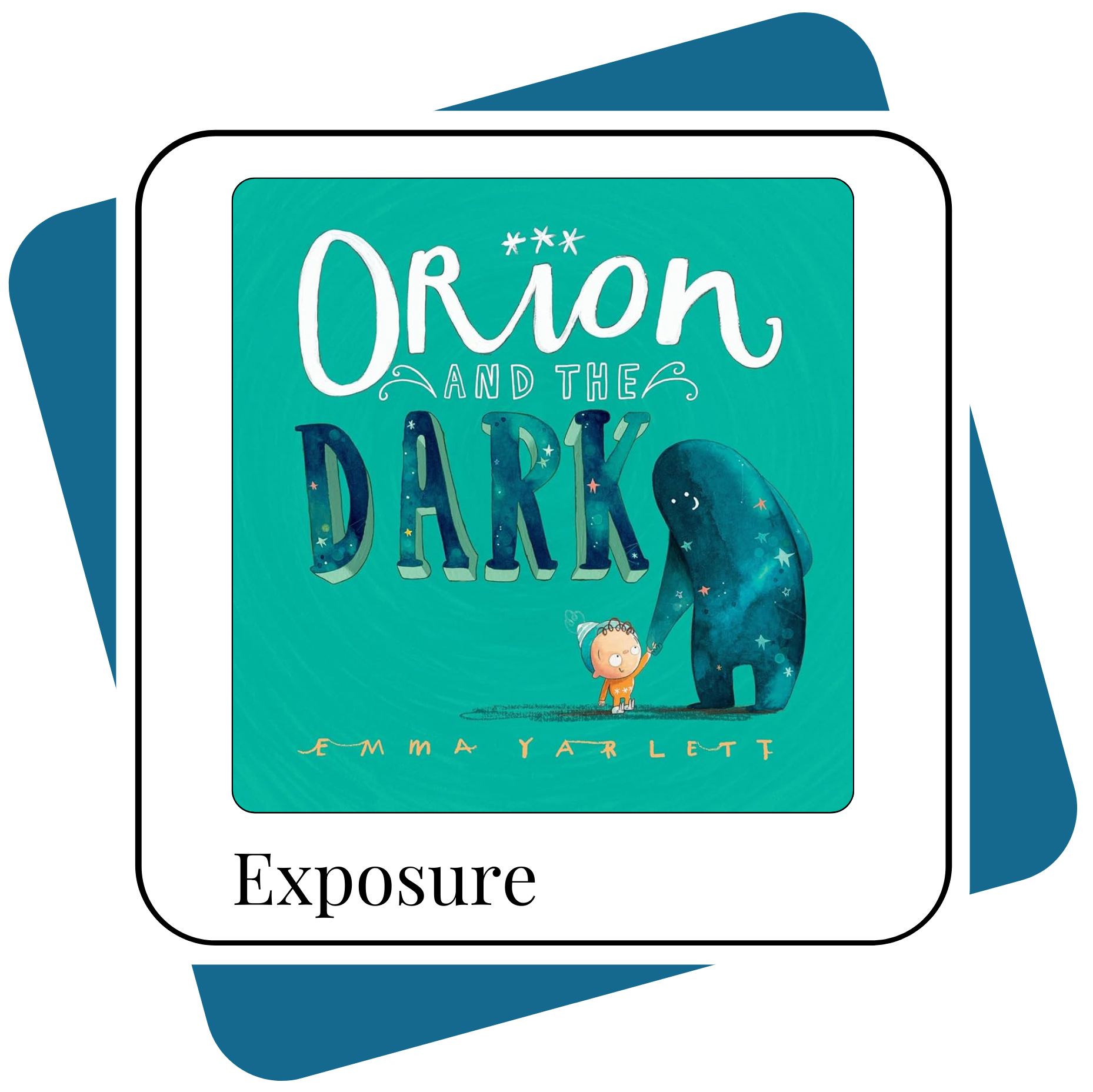
Each week, we recommend one kids book that teaches a mental health concept. Today, we’re sharing a book that tackles fear: Orion and the Dark, written and illustrated by Emma Yarlett. This book highlights the concept of exposure — the idea that approaching things we’re afraid of makes them less scary and builds confidence. Read on to learn why we recommend Orion and the Dark to the parents we know, the science behind exposure, and tips for talking to your kiddo about fear.
About the Book
Orion and the Dark features a little boy named Orion who is afraid of dogs, monsters, spiders, and the ocean, but is most afraid of the dark. One night, Orion gets so fed up that he yells at the dark to go away, and the Dark — embodied in a large, soft creature who looks like the night sky — enters his skylight. The Dark invites Orion on an adventure, and despite his fear, Orion goes along. The two explore dark and shadowy parts of Orion’s house, look for the source of scary sounds in the neighborhood, and even travel up into the scary starry sky. Orion’s willingness to move towards the thing he’s afraid of, like spending time with the Dark and visiting dark places he’s afraid of, showcases the science-backed skill of exposure.
Buy Orion and the Dark or listen online for free
What Science Tells Us about Fear
When we feel afraid, it triggers the fight or flight reaction — our brains, sensing danger, try to find ways to protect us, like telling us to hide or run away (we’ve also talked about how the fight or flight reaction relates to tantrums). In kids, “flight” behaviors aren’t always obvious, and sometimes when kids have developed a fear, they simply start avoiding the thing they’re afraid of altogether, like a child with a fear of dogs refusing to go to the house of a friend with a dog.
Avoidance works in the short term to reduce anxiety, but doesn’t get rid of the fear in the long term — if I’m afraid of dogs, I might feel better when I avoid one, but that doesn’t make me any less scared of dogs the next time I see one. Avoidance can actually even makes your anxiety worse over time — if when I avoid a dog, my brain feels relief, this can mistakenly tell my brain that dogs really must be dangerous. Avoidance also keeps us from having learning opportunities — if I always avoid dogs, my brain never gets a chance to learn that most of the time dogs are safe to be around.
To help kids break this cycle, we use a technique called exposure, a core component of cognitive behavioral therapy. Exposure is one of the most well-established treatments we have in psychology. It involves repeatedly approaching or moving towards the thing we’re afraid of, just like Orion does when he spends time with the Dark. Exposure is different than purposefully trying to scare your child or keeping them in a scary situation when they’re upset. Rather, exposure involves making a plan ahead of time with your child for ways they can start approaching the thing they fear, and then carrying out that plan. Several studies have shown that exposure is effective for treating fear and anxiety in children and adolescents. Research has also shown that exposure is more effective than other skills, like relaxation, which makes sense because relaxation doesn’t target the underlying issue of avoidance. Before fear or anxiety problems develop in kids or teens, parents can help promote a “brave” attitude by noticing things their child seems to be afraid of and helping them move towards it.
Practically, here’s how you can use exposure at home with your own kid.
Find a safe situation that they’re afraid of (e.g., dogs, vacuum, the dark, etc.). Help your child identify what they’re afraid will happen (e.g., the dog will bite me, monsters will get me). You don’t need to tell your child these things won’t happen — just talk about their belief with them plainly (e.g., “I see, your brain tells you that if you go near a dog, it will bite you.”).
Talk about how avoiding scary yet safe situations actually feeds the fear, and how “being brave” and moving towards these situations can actually help make them less scary.
Work with your child to list some steps they could take to approach the situation. You can think of easy steps and harder steps.
Try to help your child stay in the situation. For the best effect, staying in the situation for up to 20 minutes can help kids learn that the situation is safe. If they start to feel bored instead of terrified, you are on the right track!
Afterwards, ask your child about whether the thing they were afraid of happening actually happened (e.g., “I know your brain was telling the dog would bite you if you went near it. Did the dog bite you?”). This helps your child’s brain start to build new connections between the thing they fear and ideas of safety (sometimes we talk about “recalibrating your brain’s danger meter”).

What Marin likes about Orion and the Dark: The narration in this book is such a beautiful illustration of how our feeling of fear can become a companion that joins us while we practice being brave, like how The Dark joins Orion. Sometimes we think that exposures should “get rid” of our scared feelings, but in reality, exposures are a practice that focuses on bringing our hard feelings along while we keep trying new things. The dreamy illustrations remind me that there is a vast world for all of us to explore and be curious about, one step at a time. Inviting our feelings of fear along is often the key to taking a step forward.
What Betsy likes about Orion and the Dark: I love how Orion discovers that some of the darkest places — like the closet, under the bed, and in the basement — are actually the most fun! Fear can drown out other emotions, but when we are brave and go towards the things we’re afraid of, it opens us up to new experiences. There’s actually some brand-new research showing that experiencing positive emotions like hope and joy after an exposure is related to exposure therapy working well. Sometimes in therapy we even use humor or make fun of the thing we’re afraid of (“Silly dark, you made goofy noises to try to scare me!”), which can help bring positive emotions to exposure work.
Buy Orion and the Dark or listen online for free
We think Orion and the Dark would be a great addition to any child’s library. We’d love to hear your reactions to this review and your questions about exposure — we’ll highlight some answers in future posts. Reply to this email, or join our community to leave a comment!
FYI: The links above for buying Orion and the Dark are affiliate links (see this page for more information).
I liked the Orion and the Dark book very much, for the playful and imaginative way Orion was able to expose himself to his fear - the Dark, and also notice the surprisingly good things he learned by doing that.
I agree also with Dr.s Marin & Betsy’s reflections on the book.
I’m wondering if they would advise caregivers to talk beforehand with kiddos about the possible good emotions that might come up during the planned exposure, or would it be best to wait for after they’ve had the chance to actually observe that positive emotions were expressed by their kiddo?