



Clinical psychologists picking kids books rooted in mental health science 🌸
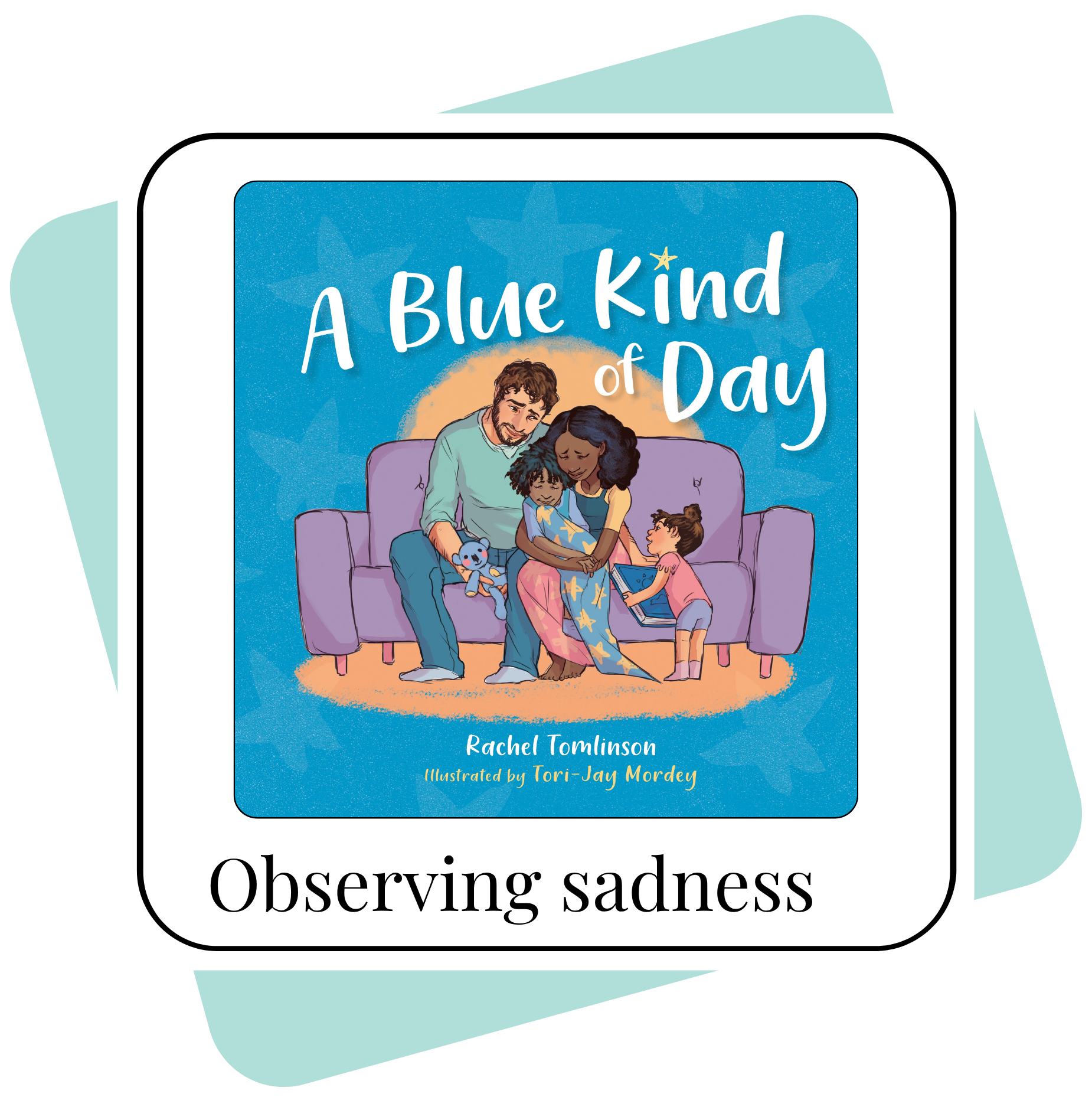
A Blue Kind of Day: A picture book about sadness for preschoolers (3+)
Each week, we recommend a kids book that teaches a mental health concept. Today, we’re sharing a book that tackles sadness: A Blue Kind of Day, written by Rachel Tomlinson and illustrated by Tori-Jay Mordey. This book highlights how observing negative emotions — which means noticing and not fighting emotions like sadness — can actually make them less sticky. Read on to learn why we recommend A Blue Kind of Day to the parents we know, the science behind observing emotions, and tips for talking to your kiddo about sadness.
About the Book
In A Blue Kind of Day, Coen is feeling sad and gloomy. His family tries to help — by telling jokes, distracting him, and offering to play outside — but nothing helps Coen feel better. Eventually, his family stops trying to offer solutions and, instead, they snuggle close to him and just stay with Coen through his sadness. Through catchy alliteration (“a slumping, sobbing, sighing kind of day”) and vivid descriptions (Coen “felt like a lost kite: loose in the breeze, with feelings that tangled like string”), we love this psychologist-written book that shows how letting go of the fight against sadness can help it pass.
Buy A Blue Kind of Day or listen to the author read it for free
What Science Tells Us about Observing Sadness
Any parent knows that it is typical for kids to feel sad or down at times. This has been shown by research, too: studies have highlighted that preschoolers, children, and adolescents have different levels of sadness from day to day. Feeling sad one day but not the next is a completely normal part of childhood.
If that is the case, why do some people stay sad? Part of what can make regular feelings of sadness stick around is how we react to them — fighting emotions, like saying “it’s bad that I’m feeling sad right now," can actually make sadness stronger. This is because emotions don’t take orders — when we’re feeling sad, we can’t force ourselves to stop feeling that way. Fighting or trying to push away negative emotions often just makes us feel worse.
What to do instead? There is research showing that observing negative emotions can make them less strong and less sticky. Observing a negative emotion doesn’t mean that you want to feel that way — it just means that you’re willing to acknowledge that the feeling is there without fighting it. This can look like saying “I am feeling sad right now” rather than saying “I shouldn’t feel sad right now.” Practicing observation means letting even unpleasant thoughts and emotions come and go, without trying to change them or push them away.
We know that observing emotions is helpful because it is part of a well-established treatment for depression called acceptance and commitment therapy, or ACT. A meta-analysis (a study that combines other studies) found that observing emotions is part of how ACT works to reduce symptoms of depression (and anxiety).
Putting these ideas together, parents can help encourage their children to practice observing negative emotions like sadness by:
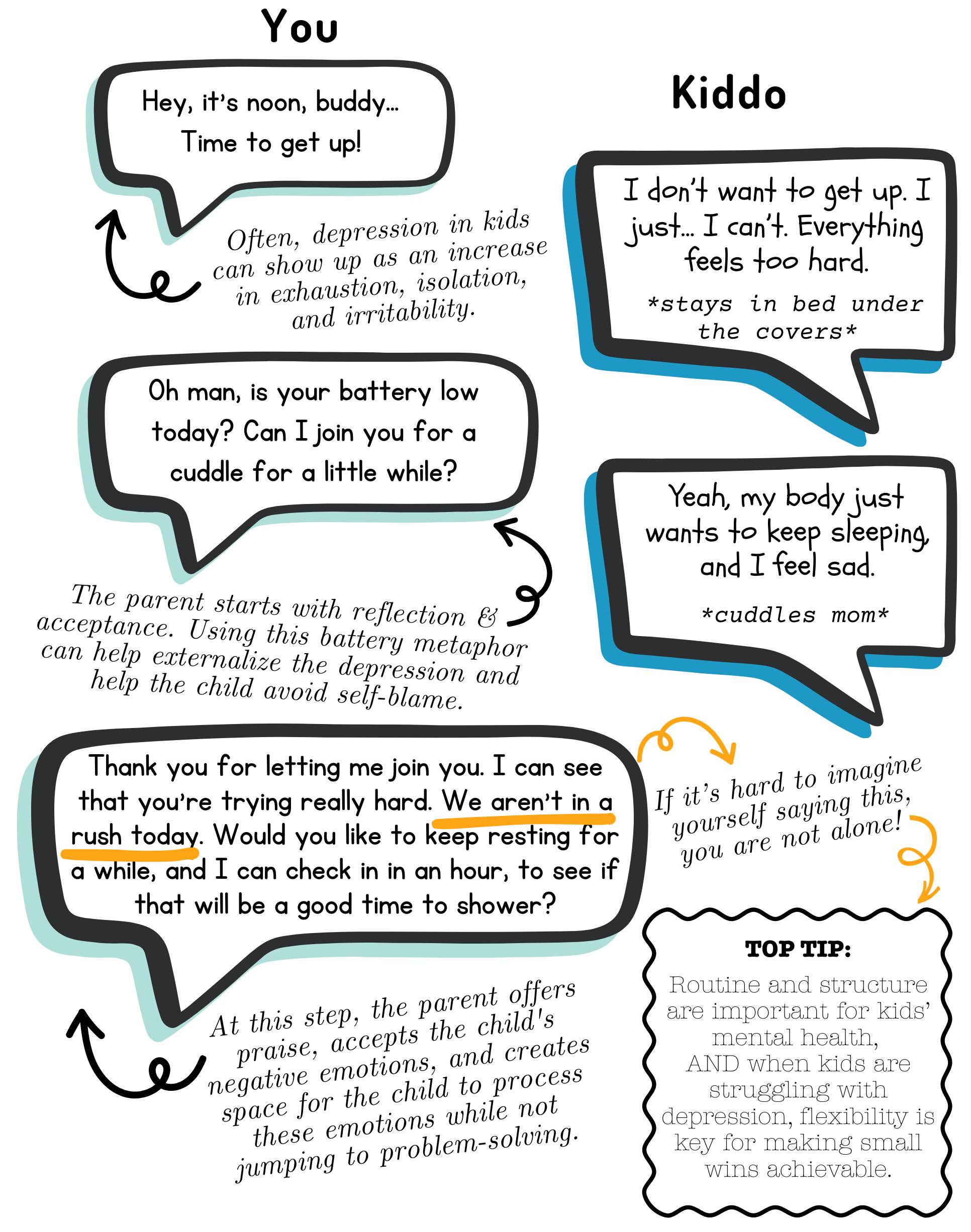
Observing your child’s emotions by using reflective listening to validate their feelings. See our handout for examples of reflective listening! 🌸
Observing your own emotions, and talking about them, in front of your child: “I think I am feeling sad right now, because I’m missing my sister.”
Using metaphors to talk about how emotions come and go, but don’t define us. We like to say, "I am like the sky, and my emotions are the weather. Like storms, big emotions may come, but they don’t last forever.” This helps convey that even when we are feeling big negative emotions, that doesn’t mean that we ARE the negative emotion. It also reminds us that, just like we wouldn’t get angry at a storm for raining, we don’t need to get upset with ourselves for feeling sad.
How to Talk About Sadness with Your Child
Try out these prompts when your kiddo is feeling sad:
What Betsy likes about A Blue Kind of Day: One important aspect of observing sadness is acknowledging how sadness comes and goes and falls and rises over time. We can observe our emotions while being curious about how they may change as time passes (like the weather!). This is illustrated beautifully in A Blue Kind of Day when Coen’s family snuggles in with him and waits “because Coen’s blue feelings would not last forever.” Being curious about emotions helps us stay present and catch when the storm of feelings starts to fade.
What Marin likes about A Blue Kind of Day: Part of why Coen’s family knows that his sadness won’t last forever is because emotions can’t stay super strong for a long time. Have you ever been in a room with a stinky smell? You probably noticed that if you acknowledged the bad smell and then kept going about your day, eventually you stopped smelling it because your brain couldn’t keep sending that strong signal forever. Hard feelings like sadness and anxiety work the same way — if you sit with an uncomfortable feeling for long enough, it will eventually start to get less intense, and may eventually go away.
Go deeper into the science of sadness and observing feelings:
You can practice observing sadness with your child by using the Minds in Bloom guide on Reflective Listening to talk openly about sadness and other hard feelings. This is one of our go-to communication skills for parents! 🌸
This 1-minute video from Sesame Street shows how powerful a parent’s care and comfort can be when a child is feeling sad.
We love this article by a child life specialist on why crying is okay, and how parents can respond to crying.
Parents interested in learning more about the research on emotions and sadness — and parents who just like Pixar movies — will might enjoy this 4-minute BrainCraft episode about sadness. She tackles the myth that feeling sad is wrong or shameful.
If you want to better understand the warning signs for depression in kids, and the steps you can take to find care, check out this video webinar by SAMHSA or read their slides on the topic.
Buy A Blue Kind of Day or listen to the author read it for free
We think A Blue Kind of Day would be a great addition to any child’s library. We’d love to hear your reactions to this review and your questions about sadness. Reply to this email, or join our community to leave a comment!
FYI: The links above for buying A Blue Kind of Day are affiliate links (see this page for more information).
I really liked this book, A Blue Kind of Day. Most of us would probably react the same way Coen’s family did at first. If a child in our family was expressing sadness like Coen’s, we would be concerned and think the best thing to do is to stop or change the sad emotions. How wonderful it was to watch Coen’s family turn instead to staying, comforting & waiting with him for the strong feelings to pass. The Minds In Bloom scientific evidence, as well as talking tips, are very helpful for preparing ahead to offer acceptance and comfort during times of sadness in our kiddos, or anyone else. To rule out more serious depression, the provided link can give good guidance, also. Thanks MindsInBloom!!