



Clinical psychologists picking kids books rooted in mental health science 🌸
Creature of Habit: A picture book about flexible thinking for preschoolers (age 3+)
Each week, we recommend one kids book that teaches a mental health concept. Today, we’re sharing a book that helps kids who have a hard time with change: Creature of Habit, written by Jennifer S. Smith and illustrated by Leo Espinosa. This book highlights the concept of flexible thinking — being able to try new ways of doing or saying things. This skill boosts emotional well-being by helping kids handle changes, solve problems, and build relationships with others. Read on to learn why we recommend Creature of Habit to the parents we know, the science behind flexible thinking, and tips for talking to your kid about trying new things.
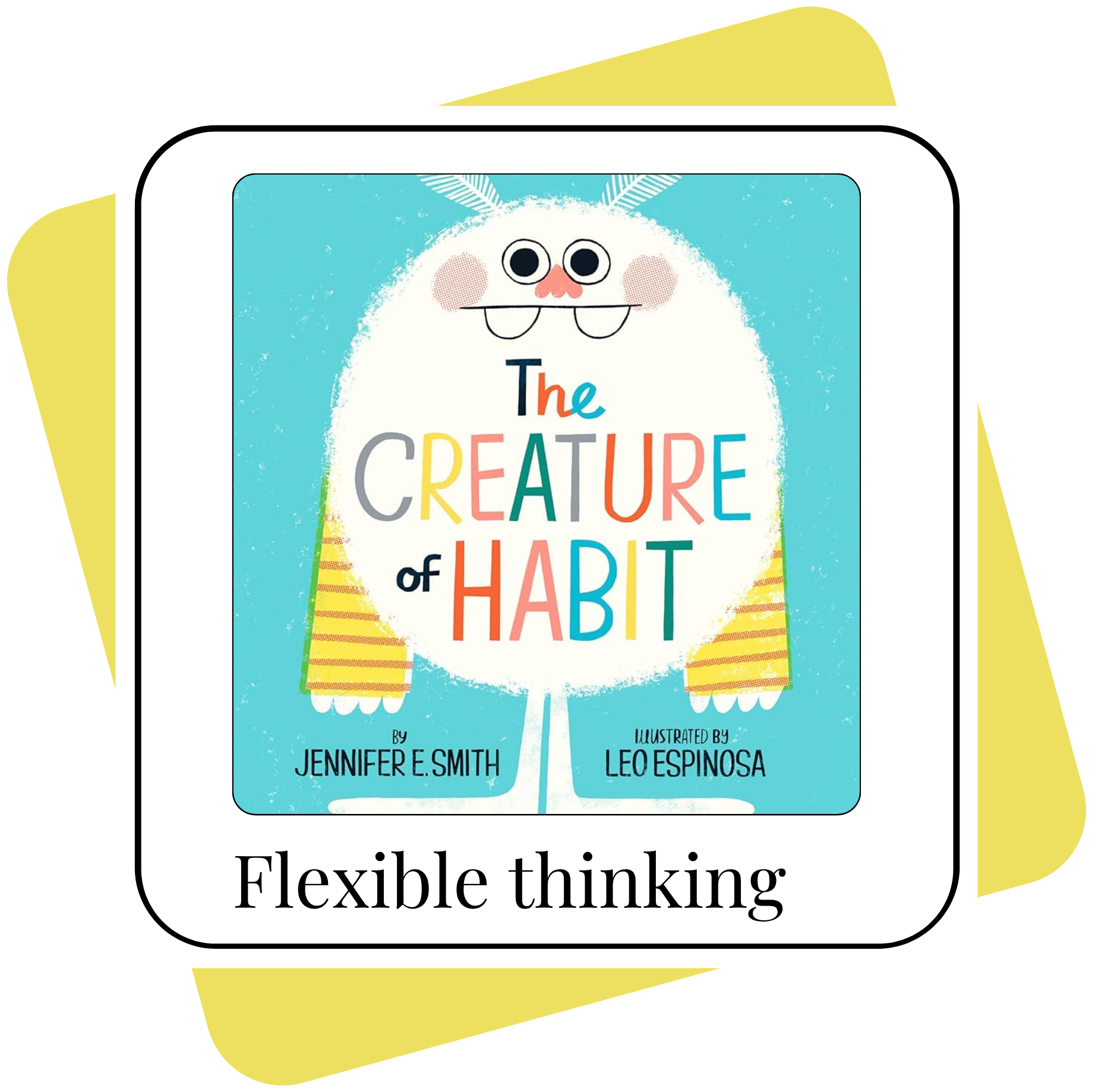
About the Book
In Creature of Habit, a round creature with big eyes, big teeth, and giant feet lives on Habit Island. The creature happily follows the same routine every day — eating only his favorite fruits for breakfast, greeting only certain fellow islanders, and looking only for his favorite shells. The creature likes this routine. But then a new creature shows up on the island who doesn’t follow any sort of routine. This opens the creature’s mind to the possibility of doing things differently, and the creature begins to experiment with breaking out of his comfort zone. In the end, the creature realizes that even small changes can lead to big rewards!
Buy Creature of Habit or listen to the author read it for free
What Science Tells Us about Flexible Thinking
Flexible thinking is the ability to adapt as we come across new situations or problems. This can look like staying calm when things don’t go as planned, being okay with change, and feeling confident trying new experiences. On the other hand, inflexible thinking can look like being stuck in routines (like always putting on socks before pants), insisting that things stay the same (like always wanting to sit in the same chair for meals), or having a hard time switching from one thing to the next (like getting upset when it’s time to leave the playground).
Flexible thinking is related to emotional well-being and cooperative behavior. A study of over 15,000 kindergarteners found that kids with high levels of flexible thinking had fewer emotional problems like anxiety, loneliness, low self-esteem, and sadness by the time they got to second grade. They also had fewer behavioral problems like arguing, fighting, or acting impulsively. This pattern has been shown for preteens and adolescents, too.
Why is flexible thinking related to emotions and behavior? Researchers think that flexible thinking helps kids shift their behaviors more smoothly. For example, if a teacher asks a kid to stop running in circles, kids who think more flexibly might have an easier time switching to a new activity, like sitting in their chair. In other words, thinking flexibility may make it easier for kids to “redirect.” This type of switching is especially important when adults ask kids to stop unsafe or disruptive behaviors, like hitting or yelling. Flexible thinking can also help kids understand that expectations for how to act change depending on the setting — for example, that it may be okay to yell outside, but we expect quiet voices indoors. When a child has trouble shifting their understanding of what’s appropriate in different situations, it might look like they’re “acting out,” but really they’re having trouble understanding and adapting to changing expectations. Flexible thinking makes it easier for kids to understand changing expectations, too.
A similar pattern is true for emotions. When a kid is feeling sad because someone else is playing with the toy they want to use, flexible thinking might help them shift their attention to a different toy, allowing their sadness to fade as they start doing something new. In contrast, inflexible thinking might cause the child to remain focused on the toy they can’t have, which might keep them feeling sad.
The relationship between flexible thinking and behavior may be especially important for neurodivergent kids, who can find it particularly hard to shift between tasks. One study tested whether it’s possible to strengthen flexible thinking by randomly assigning about 70 kids with autism* to either an intervention that included flexibility training or a control group. The autistic kids* who received the flexibility training had an easier time transitioning between activities, following rules, and adapting to change in the classroom. Although the study was small, it suggests that kids who practice can improve their flexible thinking, and this can lead to positive changes in behavior. All the more reason to work on flexible thinking with your child!
How to Talk About Flexible Thinking with Your Child
Try out these prompts for practicing flexible thinking with your kid:

What Marin likes about Creature of Habit: I loved how this book was very non-judgmental when describing the creature’s preference for his routine and habits. The book doesn’t indicate that there’s anything wrong with his routine or his desire to do specific activities in specific ways. The book doesn’t show the creature as sad, angry, or disappointed with his routine. Instead, the author chose to focus on the deeper and broader joy that can be found when we get curious and challenge ourselves to try something new!
What Betsy likes about Creature of Habit: This book shows that the creature has mixed feelings about changing up his routine — he is both curious and so nervous about making a change! This felt so real to me. One of the reasons he decides to mix up his routine is because it allows him to spend time stargazing with his new friend. I love how this book highlights that we’re often happy and comfortable on our own little “islands,” and how bravely shaking things up can help us build strong relationships with others.
Go deeper on the science of flexible thinking:
For parents wanting to dive deeper into the science, we love this academic article on why flexibility matters. It shows that from kindergarten to middle school, when kids learn to adjust their thinking, they’re building new brain and behavioral skills that support social and emotional well-being across development.
To learn more about how you as a parent can model flexible thinking for your child, check out this article by the Child Mind Institute.
Continue practicing flexible thinking with some of the fun games and activities suggested by the Center for the Advanced Study of Teaching and Learning at the University of Virginia.
It can be frustrating for parents when their kids are struggling with transitions or stuck in a routine! To find some strategies for managing your own stress during difficult parenting moments, check out our “Parents’ Guide to Keeping Your Cool” handout. 🌸
Buy Creature of Habit or listen to the author read it for free
(*Read here about how we refer to autism.)
We think Creature of Habit would be a great addition to any child’s library. We’d love to hear your reactions to this review and your questions about flexible thinking. Reply to this email, or join our community to leave a comment!
FYI: The links above for buying Creature of Habit are affiliate links (see this page for more information).
I watched the video of Creature of Habit that was linked, and I thought this book was so charming and did a great job representing the benefits of flexible thinking in terms of recognizing each other’s individual approaches to life, and being willing to try some different ways of doing things in order to enjoy life together. With those positive feelings regarding flexible thinking that the book left me with, I was so excited to learn that science has shown that children can be trained to strengthen this skill, and that this will make it easier for kiddos to collaborate with peers, teachers, and parents/caregivers. I never thought about how important it is to work on being willing to be flexible sometimes! Thanks :)