

100 little faces: How photos of real kids' feeling faces can boost your child's emotional intelligence
Pick of the week: April 28, 2026


Clinical psychologists picking kids books rooted in mental health science 🌸
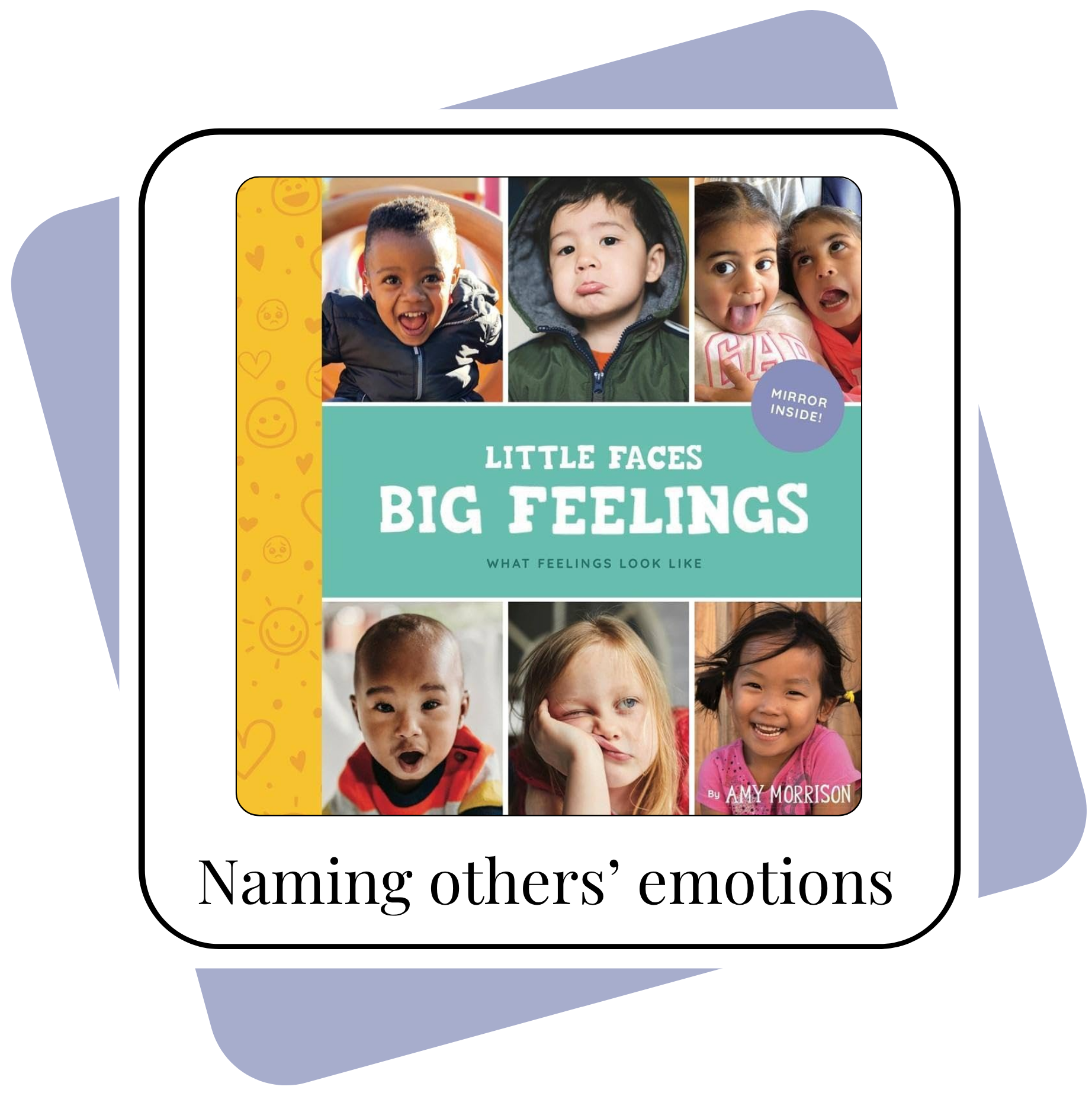
Little Faces Big Feelings: A board book about naming others’ emotions for toddlers (age 1+)
Each week, we recommend one kids book that teaches a mental health concept. Today, we’re sharing a book that tackles feelings: Little Faces Big Feelings: What Emotions Look Like, by Amy Morrison. This book highlights the value of naming emotions in other people — the idea that noticing and naming other people’s feelings helps kids grow their emotional intelligence, laying the foundation for strong social relationships, cooperative behavior, and mental well-being. Read on to learn why we recommend Little Faces Big Feelings to the parents we know and the science behind the development of emotional awareness.
About the Book
Little Faces Big Feelings is an incredible board book with pictures of tons of kids experiencing real emotions! Each page highlights a different emotion — like happiness, fear, bravery, silliness, and surprise — and shows 100+ real kids experiencing these emotions. We love how this book highlights how a single emotion can look differently on different people’s faces. There’s also an emotion wheel and a mirror at the back of the book for you and your kiddo to practice making different emotion faces together!
Buy Little Faces Big Feelings or preview most of the book here
What Science Tells Us about Naming Others’ Emotions
A core part of emotional development is learning to make educated guesses about how other people are feeling, based on their facial expressions, body language, or tone of voice. As it turns out, this is an incredibly important life skill. Kids who have better abilities to figure out what other people are likely feeling do more prosocial behaviors like sharing and helping, are more liked by their peers and seen by their teachers as more socially skilled, and have less depression, anxiety, and disruptive behavior. These results are so strong that in research following kids over time, preschoolers with more emotion knowledge have more social skills when they reach kindergarten, and kindergarteners with more emotion knowledge have better social skills, more academic success, and fewer behavioral problems when they reach third grade.
Parents can help kids learn to notice and label other people’s emotions by making emotion talk as part of everyday family life, and by practicing linking emotions to situations and circumstances. You can do this by:
Noticing how emotional expression varies within your family (“What does it look like when Mom is feeling sad? How do you know when your brother is sad?”)
Talking about emotions you notice on other people when you’re in public, like a child crying at the park (“That baby looks sad. Maybe he is sad because he doesn’t want to leave the playground”).
Pointing out and asking questions about how different characters might be feeling when reading books together (“The girl looks happy! Maybe she is happy because she got to dress up as a ladybug!”)
Labeling your own emotions using non-judgmental language in front of your child (“I’m feeling frustrated because I can’t find my keys!”)
Researchers talk about something interesting about emotions — two people feeling happy might have two different facial expressions, and two people with the same facial expressions might be feeling two different emotions. There is not a universal way a face looks or moves when a person is experiencing an emotion. Books like Little Faces, which show many different people’s faces as they experience the same emotion, may be particularly helpful for conveying this idea.
Kids tend to gain the ability to recognize emotions in others in a specific order. A recent meta-analysis (a study which combines the results of other studies) showed that kids tend to have the easiest time recognizing happiness and the hardest time recognizing disgust and fear. Why does it go in that order? Recently, some very cool researchers used wearable cameras to record what toddlers see in everyday situations at home. They found that a) toddlers don’t see that many emotion faces in their daily lives (perhaps because toddlers are not at face level with members of their family), and b) the most common emotion toddlers see from family members is happiness - aw! The researchers think the frequency of exposure to happy faces may be why kids learn to recognize happiness first.
The fact that toddlers don’t naturally see a lot of emotional expressions in their daily lives hints that it could be helpful expose toddlers to examples of real emotions to help them learn about the wide range of emotions humans experience. There’s a good reason to think that photo books might be a good way to do this. Researchers have found that kids as young as 9 months old can learn about the world from looking at realistic pictures, and another study found that 15- to 24-month-olds were more likely to learn from highly realistic images like photos than from less realistic ones like cartoons. We also know that the “own-age” bias makes kids recognize other kids’ faces more accurately than adult faces. Taken together, this suggests that books with realistic photos of children showing a range of emotions - like Little Faces - may be an especially effective, convenient way to support kids’ emotional learning.

What Marin likes about Little Faces Big Feelings: I thought this book did a fantastic job of showing the diversity of ways a single emotion can be expressed. While it is fun to notice the similarities in how the ten photos capture expressions of silliness or boredom, it's equally educational to notice the subtle differences in how each kid conveys that emotion in their snapshot. This book (and all the books published by Little Feminists!) also does an amazing job of featuring kids with a wide diversity of ages, body types, skin colors, and abilities. The effort they made to represent so many different kids’ experiences of the world sparked a lot of joy and curiosity in me!
What Betsy likes about Little Faces Big Feelings: In addition to my love of all the cute kid photos, I also love the way Little Faces talks about emotions in a non-judgmental way: “Feeling scared is okay. No feeling is wrong” and “Mad or frustrated? Can you tell? Big emotions can make us yell.” This messaging reminds me of how we can notice emotions like sadness or anxiety without labeling them as wrong or bad.
Buy Little Faces Big Feelings or preview most of the book here
We think Little Faces Big Feelings would be a great addition to any child’s library. We’d love to hear your reactions to this review and your questions about naming others’ emotions— we’ll highlight some answers in future posts. Reply to this email, or join our community to leave a comment!
FYI: The links above for buying Little Faces Big Feelings are affiliate links (see this page for more information).
Knowing how my children loved little board books that had real baby photos, I can see how this book would also resonate… might have to add this to the permanent collection!