



Bite-sized mental health skills for real parents 🌸
Last week, we recommended Frannie the Food Explorer, which highlights the concept of food exposure — the idea that approaching avoided foods in a structured way (by exploring them with all five senses) can help kids overcome picky eating (read that post here). This week, we share some resources to try food exposure with your kiddo at home, and answer your real-life questions about picky eating.
Buy Frannie the Food Explorer or listen to Marin read it for free and see a demonstration of sensory food exposure on our new YouTube channel!
How to Try Out Food Exposure with Your Child
We want to make practicing food exposure using sensory exploration feel as approachable as possible. Here are some ideas of how you can encourage your child to have a “food explorer” mindset. We’ve included some comments to help you understand why we recommend these steps.
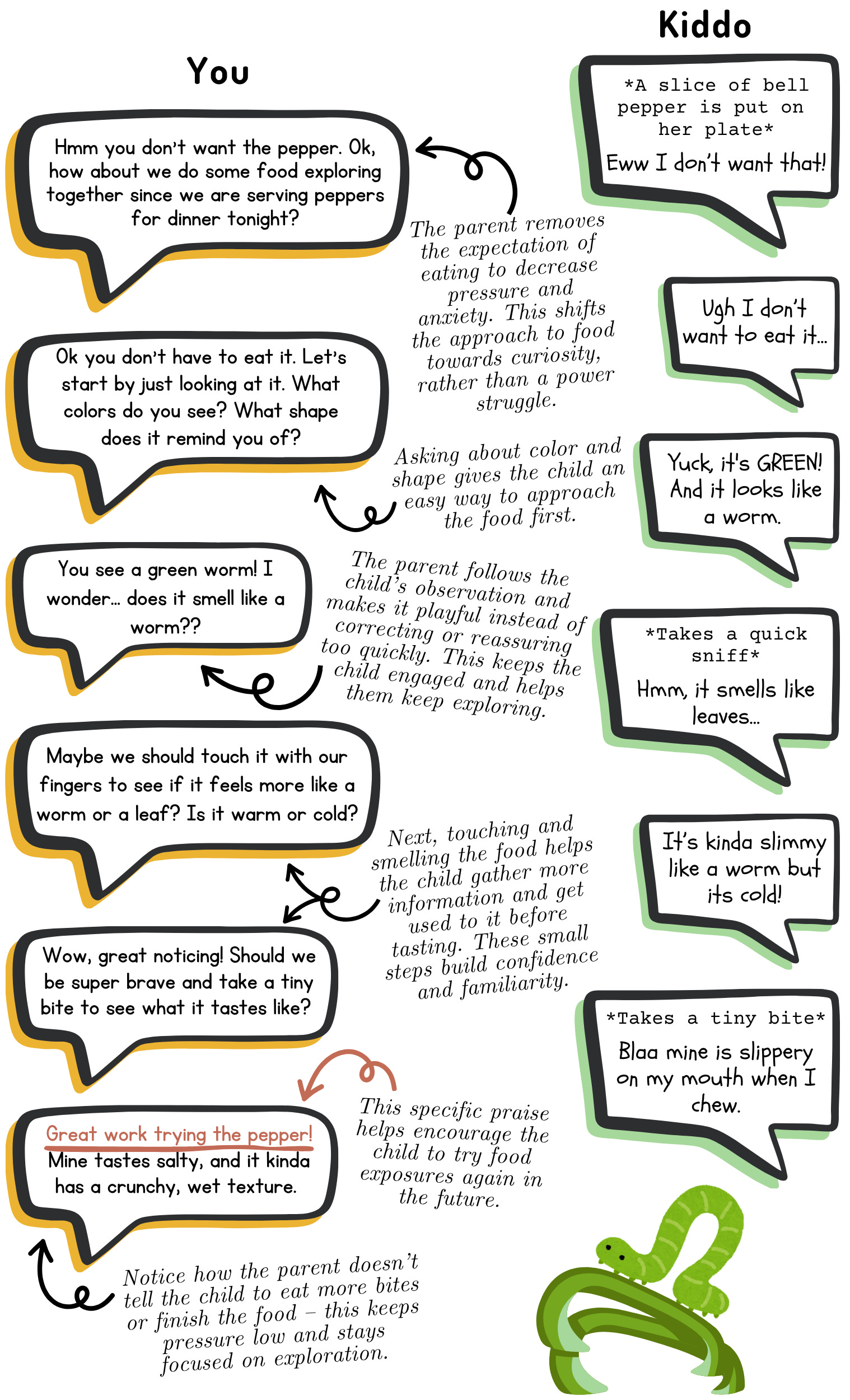
This is an example of an initial introduction of a disliked food. Note that we wouldn’t expect this single exposure will make the child suddenly start liking bell peppers. The parent will need to repeat the exposures (maybe even many times over many weeks) to decrease the child’s anxiety or discomfort about bell peppers. Parents can continue to build brave practices that vary the way the child is exposed to the disliked food (e.g., different temperatures, different colors of bell pepper, bell pepper cut or cooked in different ways ). We can also introduce the avoided food with preferred foods (e.g., serving the bell pepper on pizza, if the child likes pizza; served next to chicken nuggets, if the child likes chicken nuggets).
Questions From Our Community About Food Exposure
Q: After reading one of the books you recommended on anxiety, my son asked, “What happens when kids aren’t afraid of the dark, but they are afraid of eating pasta?” I realized that standing up to fears around certain foods can feel different from other kinds of “brave practices.” Do you have any tips for helping kids with picky eating or food-related anxiety?
A: We really appreciate this kiddo and parent’s insightful question! Facing eating fears can feel different than facing other fears for both the kiddo and the parents supporting them. The good news is that the same basic ideas are at play: avoiding the feared thing keeps fear going, and gentle, repeated practice of approaching the fear helps kids learn that they can handle scary or uncomfortable situations.
For more typical fears, like a fear of the dark, kids may worry that the feared thing is dangerous in some way (“if I turn out the lights, a monster will get me”). Through exposure, we help kids practice approaching the feared situation again and again so they can learn either that it is not as dangerous as they thought or that they can handle the discomfort that comes with it. Food exposure works in a very similar way, but often the scary part is more about sensations and body experiences than a specific fear of danger. A child may feel uncomfortable or unsettled by how a food looks, smells, feels, sounds, or tastes. In our experience, oftentimes kids can’t quite articulate what they’re afraid of with foods they fear or avoid, because the fear or discomfort is more rooted in sensory experiences (“It looks gross” or “it feels weird”) than beliefs about a bad thing happening.
Research on picky eating has shown that repeated exposures to new or non-preferred foods, including taste and texture exposures like the ones we talked about in our review of Frannie the Food Explorer, can help kids become more comfortable over time. This kind of multisensory, low-pressure exploration helps kids learn, “This is something I can handle.” For both food and non-food fears, we want to support kids in taking small, brave steps instead of rescuing them from all discomfort or asking them to jump right into the deep end if they aren’t ready:
For fear of the dark, this might mean standing in a dim hallway, sitting in a dark room with a parent nearby, and then trying it alone for a few minutes.
For unfamiliar or non-preferred foods, this might mean looking at a piece of pasta, smelling it, touching an uncooked noodle, then touching a cooked noodle, licking it, and eventually taking a tiny bite (and repeating this several times).
In both situations, the goal is to build the child’s confidence through repeated practice, with gradual steps that get a little harder over time. The goal of a brave practice is to help kids stay curious about the new experience, without pressure.
Go deeper on the science of picky eating and sensory exposure:
Want more info on picky eating? We love this tip sheet from Penn State Extension, and also this deep dive from Solid Starts!
We also love this article from Raising Children Network, which talks more about the importance of playing with food and messy eating, and gives parents some ideas on how to manage the mess.
For a deep dive on the benefits of messy eating, check out this Solid Starts article, which highlights how messy eating can minimize pickiness through encouraging exploration (read the section titled “getting messy supports sensory learning”!).
You might be noticing a trend here — Solid Starts has a TON of golden information about kids, eating, and pickiness in their article library. Topics include preventing picky eating, toddler eating FAQ, food throwing in babies and toddlers, and information on what to do if your baby won’t touch a food.
One important note: if a child is losing weight, eating very few foods, gagging or vomiting often, avoiding whole food groups, or becoming very distressed at meals, parents should reach out to a pediatrician or feeding specialist. More intense food fears may need specialized support, such as from a provider who specializes in ARFID. Check out our tips on finding evidence-based treatment for your kiddo.
Are you worried about picky eating? Have you tried adopting a “food explorer” mentality or doing sensory exposure? Share your experiences or questions about helping kids try new or avoided foods in the comments!
FYI: The links above for buying Frannie the Food Explorer are affiliate links (see this page for more information).